
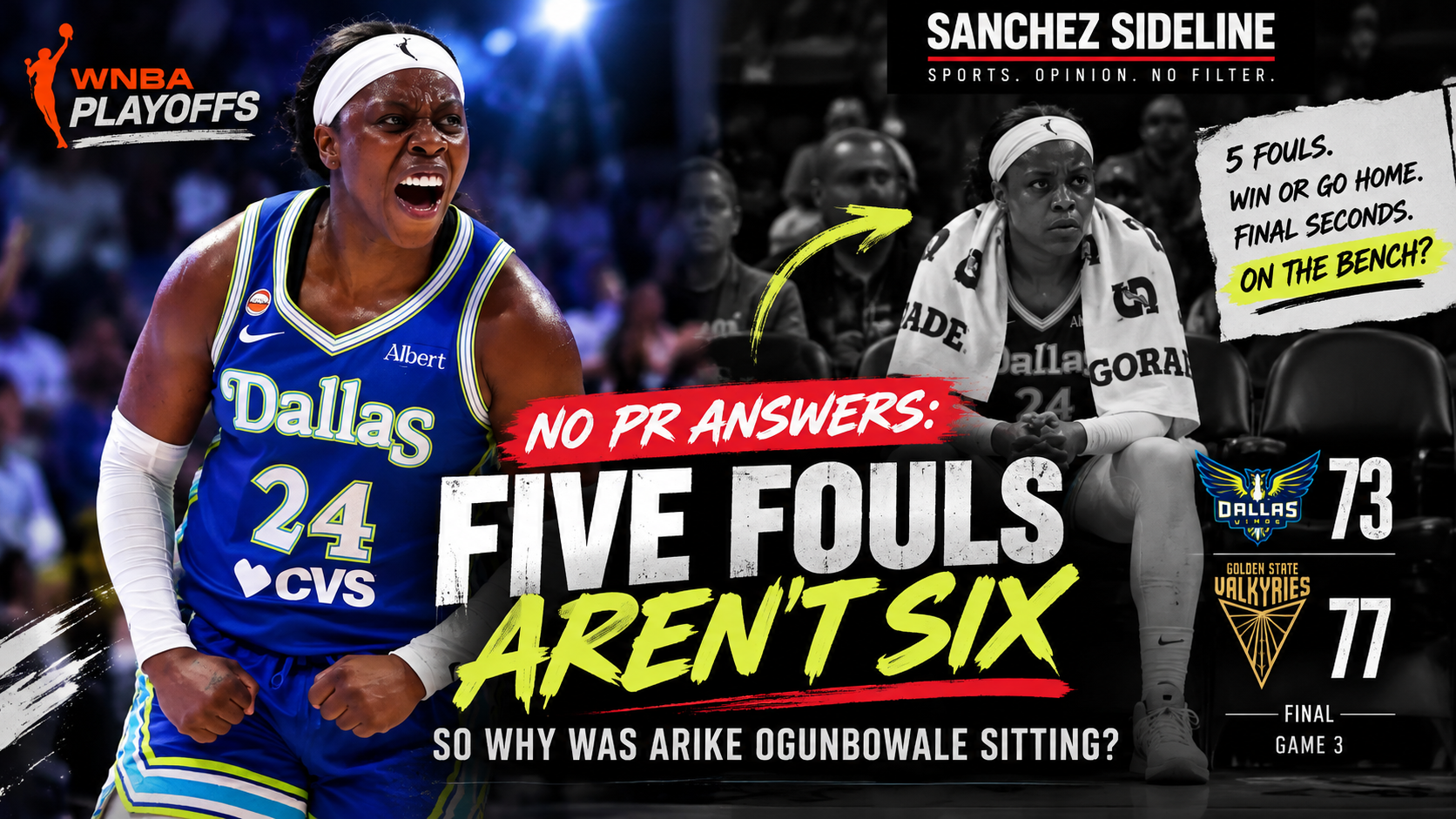
Dallas was fighting for its season. Arike Ogunbowale had 30 points. She had five fouls—not six. Yet when the Wings needed their biggest offensive weapon most, she was watching from the bench.
By Latifa Sanchez
I have been trying to make this make sense since Friday night.
I can't.
The Dallas Wings were playing a winner-take-all Game 3 against the Golden State Valkyries. Win, and you move on. Lose, and your season is over.
There is no tomorrow.
There is no “we'll learn from this and get them next game.”
There is no next game.
And somehow, with the Wings' season hanging in the balance, Arike Ogunbowale was sitting on the bench.
Yes, she had five fouls.
I know.
But last time I checked?
Five fouls aren't six.
And that's where I need some No PR Answers.
Let's Start With Who Was Sitting
This wasn't some random player who happened to get hot Friday night.
This was Arike Ogunbowale.
The same Arike who had scored a WNBA playoff-record 45 points in Game 2 to keep Dallas' season alive.
The same Arike who hit an absurd game-tying three with 4.1 seconds remaining to send that game to overtime.
Then she came back in Game 3 and gave Dallas 30 more points on 11-of-21 shooting.
So across two elimination games, Arike scored 75 points.
That is not somebody you hide from the moment.
That's somebody you hand the ball to.
Yet with the season coming down to its final possessions Friday night, Dallas' biggest offensive weapon wasn't where she needed to be.
She was sitting beside the coaching staff.
Make it make sense.
I Understand Foul Trouble. I Really Do.
Let's be fair.
Five fouls absolutely changes how you manage a player.
You don't want Arike picking up No. 6 with five minutes remaining and becoming unavailable when you really need her.
That's basketball.
I understand the logic.
But here's my problem:
Eventually, “when we really need her” arrives.
With five minutes remaining, protect her.
With three minutes remaining, maybe you steal another possession.
But when the clock is disappearing and your entire season is disappearing with it?
What exactly are we protecting her for?
The offseason?
At some point, protecting your star from fouling out becomes less important than actually having your star on the floor.
Five Fouls Aren't Six
That's really the entire argument.
Arike had not fouled out.
She was in danger of fouling out.
Those are two completely different things.
If you put her back into the game and she commits her sixth foul?
Okay.
She fouled out.
At least your season ended with your best offensive player playing basketball.
But sitting her because she might foul out while the game—and your season—is being decided?
That's where you lose me.
This isn't February.
This isn't Game 27 of the regular season.
This is win or go home.
Sometimes playoff basketball requires accepting risk.
This was one of those times.
And Dallas Had Already Let This Game Get Away
That's the other part that can't be ignored.
Dallas led Golden State 53–37 in the third quarter.
Sixteen points.
In an elimination game.
The Wings had control.
And then Golden State started chipping away.
The Valkyries kept coming.
Dallas stopped controlling the game.
And eventually that comfortable lead became exactly what nobody in Dallas wanted:
A possession-by-possession fight for the season.
Golden State's Gabby Williams eventually hit the go-ahead jumper with 1:17 remaining, and the Valkyries went on to win 77–73, eliminating Dallas.
That's exactly when I want my star.
Not protected.
Not preserved.
Playing.
Did Dallas Start Coaching Not to Lose?
That's the bigger question.
Because there's a difference between coaching strategically and coaching scared.
Managing Arike's fouls earlier in the fourth quarter?
Strategy.
Keeping her out when you're approaching the final seconds of an elimination game?
Now I have questions.
And this isn't about pretending coaches don't have difficult decisions to make.
They do.
But postseason coaching requires understanding when the normal rules no longer apply.
Sometimes the rotation gets thrown out.
Sometimes your star plays exhausted.
Sometimes somebody with five fouls stays on the floor.
Why?
Because your season is sitting right there.
There is nothing left to save them for.
Especially After What She Did 48 Hours Earlier
This is what makes the decision even harder for me to understand.
Game 2 should have eliminated any doubt about whose hands you wanted the basketball in.
Dallas was seconds away from elimination.
Arike hit the shot.
Then Dallas won in overtime.
She finished with 45 points, setting the WNBA playoff single-game scoring record.
Wednesday:
45 points.
Playoff record.
Season saved.
Friday:
30 points.
Season on the line.
Five fouls.
Bench.
I'm sorry.
We need answers.
Sometimes You Have to Trust Your Star
There are moments when coaching isn't about protecting a player from what could happen.
It's about trusting that player to make something happen.
Arike Ogunbowale had already proven she could.
And yes, maybe she comes back into the game and misses the shot.
Maybe Golden State traps her.
Maybe she turns the ball over.
Maybe she commits No. 6.
Any of those things could have happened.
But there's another possibility.
Maybe she does exactly what she did two nights earlier.
Maybe she saves you.
We'll never know.
And that's the problem.
NO PR ANSWER
I'm not saying Arike playing those final seconds automatically means Dallas wins.
Nobody can say that.
Golden State earned its victory. The Valkyries erased a 16-point deficit, made the plays late and survived a winner-take-all game.
But if I'm Dallas?
My season is not ending with my 30-point scorer sitting beside me because I'm worried she might foul out.
Five fouls aren't six.
Put her on the floor.
Give her the basketball.
And live with whatever happens next.
Because I'd rather explain why my superstar couldn't save the season than explain why I never gave her the opportunity to try.
That's the No PR Answer.
No PR spin. No excuses. Just answers.
Sports. Opinion. No Filter.
Sanchez Sideline.