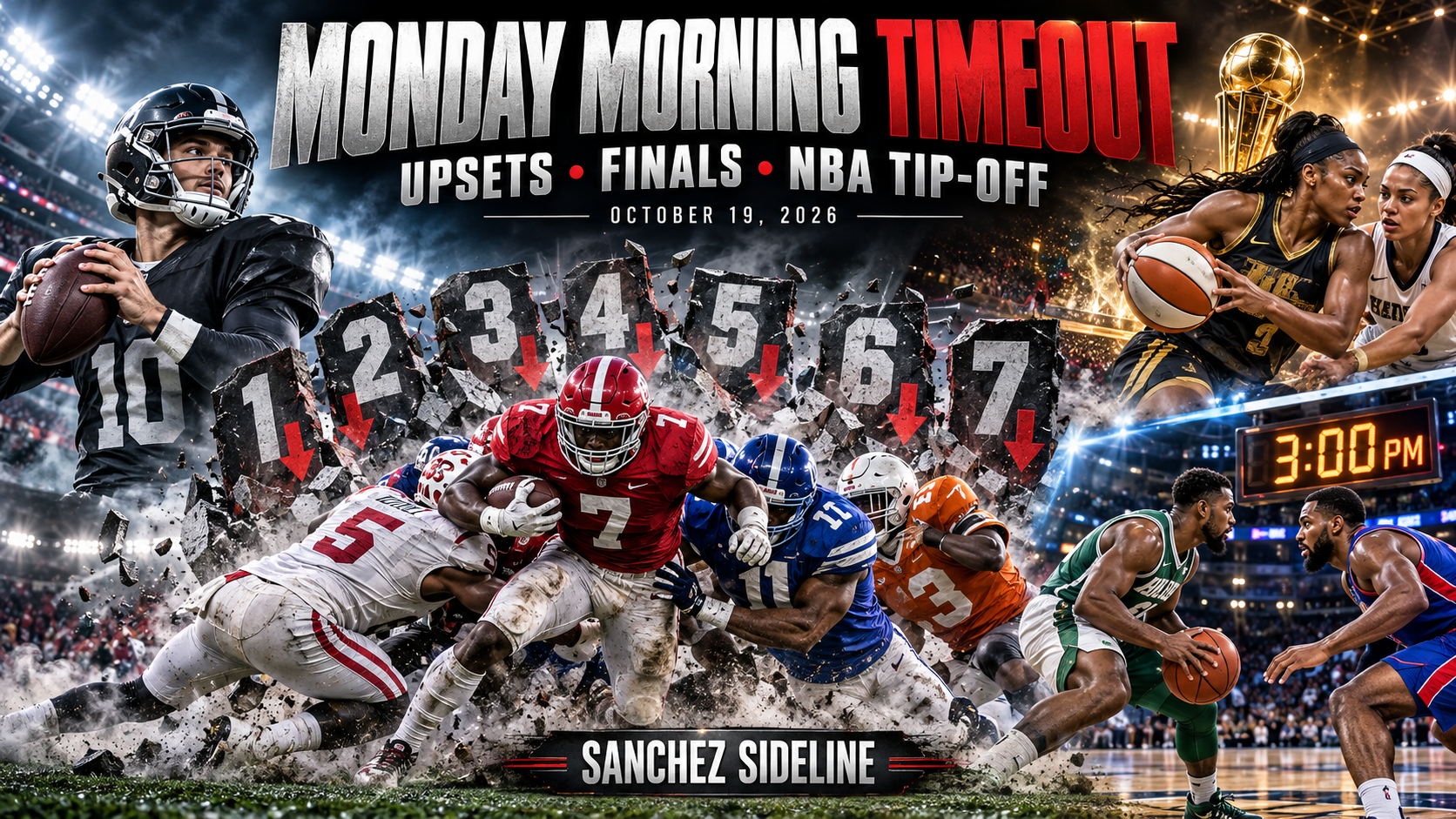
The Falcons fell to 1–5, Georgia surrendered the No. 1 ranking, the Dream gave away Game 1, and five of college football’s top seven teams went down.
By Sanchez Sideline Staff
October 19, 2026
The weekend is over. Now let’s talk about it.
Atlanta suffered three painful losses across three major stages. The Falcons continued digging a hole that may already be too deep. Georgia’s brief stay at No. 1 ended against Auburn. The Dream controlled Game 1 of the WNBA Finals before their offense disappeared when it mattered most.
And somehow, Atlanta was only part of the chaos.
Five of college football’s top seven teams lost, the NBA absorbed a brutal injury before opening week, and college basketball entered the preseason with eligibility questions and another debate about whether continuity still matters.
Welcome to the Monday Morning Timeout—big results, real takes and no PR-approved answers.
NFL: Atlanta’s Excuses Are Running Out
The Falcons lost 31–23 to Chicago, falling to 1–5 and adding another chapter to a season that is quickly becoming difficult to defend.
Caleb Williams returned from injury and helped the Bears build an early advantage. Atlanta spent the rest of the afternoon trying to recover from another slow start, another collection of costly mistakes and another performance that raised more questions than it answered.
The Falcons turned the ball over, failed to capitalize on opportunities and once again left themselves with too much work late in the game.
That is not a one-week problem.
Atlanta continues to look like a team waiting for something to change instead of creating that change. The offense has lacked consistency. The quarterback situation has provided more uncertainty than stability. The coaching staff has struggled to establish a clear identity. The front office assembled a roster that was supposed to compete immediately, yet the Falcons already look closer to another reset than a playoff push.
At some point, the conversation has to move beyond execution.
Who built this roster? Who developed the plan? Who decided this was good enough?
The Falcons cannot keep changing quarterbacks, blaming injuries and pointing toward isolated mistakes while ignoring the larger pattern. When the same problems survive multiple personnel changes, the problem is usually bigger than the player taking the snaps.
Atlanta is not simply losing.
The Falcons look unprepared to win.
The AFC North Is a Mess
Cleveland defeated Baltimore 13–10 on Andre Szmyt’s last-second field goal, creating a three-way tie atop the AFC North.
The Browns, Ravens and Steelers are all 4–2 after Pittsburgh defeated Tampa Bay 26–19 in overtime.
Baltimore’s loss was particularly damaging because the Ravens continue wasting winnable games. A roster with legitimate postseason expectations cannot repeatedly allow close games to slip away and keep treating the result like an isolated mistake.
Eventually, failure to finish becomes part of a team’s identity.
Philadelphia Received Another Warning
Carolina beat Philadelphia 25–14, handing the Eagles another performance that cannot be brushed aside.
The Panthers did not steal the game with one unusual play. They controlled it.
Philadelphia still possesses one of the league’s most talented rosters, but the offense has looked disconnected and the team has struggled to maintain control for four quarters. The Eagles remain dangerous, but reputation cannot continue doing the work their execution has not.
Other NFL Results That Matter
Tennessee finally earned its first victory, beating Indianapolis 26–20. Kansas City remained unbeaten with a 22–6 win over the Chargers, while Buffalo survived Las Vegas 33–30.
Green Bay defeated Dallas 23–13, and Houston escaped Jacksonville with a 34–31 victory in London.
College Football: Nobody Was Safe
Saturday delivered one of the most chaotic days in college-football history.
Five of the top seven teams lost during the same regular-season weekend for the first time in the history of the AP poll.
No. 1 Georgia lost. No. 2 Notre Dame lost. No. 5 Indiana lost. No. 6 Alabama lost. No. 7 Texas lost.
The rankings did not shake.
They exploded.
Auburn Ended Georgia’s Stay at No. 1
Unranked Auburn walked into Athens and defeated Georgia 27–24 on Alex McPherson’s last-second field goal.
Gunner Stockton committed three turnovers, and Georgia failed to protect an early advantage. The Bulldogs had just climbed to No. 1 after beating Alabama, but their time at the top lasted only one week.
Georgia remains talented enough to reach the College Football Playoff. That is not the issue.
The issue is whether the Bulldogs can trust their quarterback in the biggest moments.
One poor performance does not define Stockton, but three turnovers in a rivalry game cannot be reduced to bad luck. Georgia’s margin for error will shrink considerably if its offense keeps giving opponents extra possessions.
The Bulldogs fell to No. 5 in the new AP poll.
Tennessee Did Not Just Beat Alabama
Tennessee defeated Alabama 26–10.
That score matters because this was not a last-second upset or a rivalry game decided by one unusual bounce. Tennessee controlled the second half and held Alabama to 10 points.
The Crimson Tide dropped to No. 13, and the pressure around Kalen DeBoer will continue building. Alabama remains nationally relevant, but the program no longer receives the benefit of the doubt simply because of the name on the jersey.
Nick Saban is not walking through that door.
This version of Alabama must prove it can respond when punched. Right now, that proof is missing.
Texas Has a Real Problem
Florida defeated Texas 27–24, handing the Longhorns their second consecutive loss.
Texas has fallen from No. 1 to No. 19.
Arch Manning’s late-game turnovers have become part of the conversation, and Steve Sarkisian acknowledged that everything—including the quarterback position and offensive play-calling—must be evaluated.
That does not automatically mean Texas should bench Manning.
It does mean his last name should not protect him from honest criticism.
The Longhorns have one of the country’s most expensive and talented rosters. They cannot continue producing an offense this inconsistent and then act as though patience alone will fix it.
Florida deserves credit, especially after freshman quarterback Tramell Jones Jr. delivered in his first start. But Texas must stop behaving like its preseason expectations still count in the standings.
They do not.
Miami and BYU Take Control
Miami survived Florida State 43–35 in double overtime and moved to No. 1 for the first time since 2002.
BYU beat Notre Dame 28–24 and climbed to No. 2, its highest ranking since the Cougars’ 1984 national-championship season.
Ohio State moved to No. 3 after ending Indiana’s 22-game winning streak, while Notre Dame remained No. 4 despite the loss.
The expanded playoff gives the defeated contenders room to recover. It should not eliminate the consequences of losing.
If every highly ranked team can survive multiple bad losses because its brand remains valuable, the regular season begins losing some of the urgency that made Saturday so compelling.
WNBA Finals: Atlanta Gave Game 1 Away
The Atlanta Dream did enough to win Game 1.
Then their offense disappeared.
Golden State defeated Atlanta 68–64, taking a 1–0 lead in the WNBA Finals after holding the Dream to eight fourth-quarter points.
Atlanta entered the final period ahead by five. The Dream then shot 2-for-19 from the field, missed all seven of their three-point attempts and failed to score during the final three minutes.
That is not simply good defense.
That is an offensive collapse.
Angel Reese finished with 14 points and 12 rebounds but did not score after halftime. Allisha Gray led Atlanta with 19 points but was also held scoreless in the fourth quarter. Rhyne Howard struggled with turnovers and late-game decision-making.
Meanwhile, Gabby Williams gave Golden State exactly what a Finals game requires. She scored 26 points, controlled the second quarter and delivered the late free throws that closed the game.
Atlanta’s defense was good enough to win a championship game on the road.
Its late-game offense was not.
Head coach Karl Smesko must find a way to keep Reese involved after halftime, create cleaner actions for Gray and prevent Howard from being forced into rushed decisions as the shot clock expires.
Game 2 is Monday night at Chase Center. Atlanta does not necessarily face a must-win game, but returning home down 0–2 would place immediate pressure on a team that just watched a valuable road opportunity disappear.
The Dream do not need a complete reinvention.
They need to stop abandoning what worked.
NBA: Ben Simmons’ Comeback Ends Before Opening Night
Ben Simmons’ attempt to restart his career in Sacramento suffered a devastating blow Sunday when he tore his right Achilles tendon during practice.
Simmons will undergo surgery and is expected to miss the 2026–27 season.
The injury occurred during a live drill, only days before Sacramento’s season opener against the Los Angeles Clippers. Simmons had appeared in two preseason games and was beginning to carve out a role as a versatile ball-handler and defender.
Sacramento signed Simmons to a one-year deal after he missed the entire 2025–26 season while dealing with back problems. His preseason production—10.5 points, four rebounds and four assists per game—offered some hope that the former No. 1 pick could finally begin rebuilding his career.
Now the conversation shifts from comeback to recovery again.
For the Kings, the injury creates an immediate depth problem. Sacramento expected Simmons to provide size, defensive flexibility and secondary playmaking. Rookie Darius Acuff Jr. may now be asked to handle more responsibility earlier than planned.
For Simmons, the human side should not be ignored. His career has become a punchline in too many conversations, but another major injury is not funny. This is a 30-year-old player facing surgery and another lengthy rehabilitation after finally working his way back onto an NBA court.
Critique the basketball when basketball is being played.
This is bigger than that.
Opening Week Questions—and One Bizarre Tipoff Time
The NBA regular season arrives with roster cuts being finalized and rotations taking shape.
The preseason scores will be forgotten quickly. The important questions are which young players earned real minutes, which veterans will begin the year under workload restrictions and which teams discovered that their depth is not as strong as advertised.
Sacramento has already received the harshest possible answer.
But here is another question: Why are the Celtics and Pistons opening the NBA season at 3 p.m. Eastern on a random Tuesday?
The matchup is scheduled early because it opens NBC and Peacock’s three-game Tip-Off tripleheader. Boston and Detroit are followed by Philadelphia at New York at 7 p.m. and San Antonio at Oklahoma City at 9:30 p.m. The Celtics and Pistons also finished with the Eastern Conference’s two best records last season, so the league wanted the matchup showcased without competition from the evening games.
The broadcast strategy makes sense.
The fan strategy does not.
A nationally televised season opener should feel like an event, but scheduling it while much of the audience is still working or in school limits who can actually watch it live. If the NBA wants to build an Opening Day tradition similar to the NFL or Major League Baseball, it must do more than place three games on television. The schedule has to feel accessible, intentional and worthy of fans organizing their day around it.
Instead, Boston and Detroit received a prominent matchup in a time slot that feels like an exhibition game.
The league created a tripleheader. It forgot that most fans still have jobs on Tuesday afternoon.
College Basketball: The Season Has Not Started, but the Drama Has
College basketball is still in the preseason, but the roster and eligibility battles are already producing meaningful storylines.
Mark Mitchell’s Eligibility Fight
Missouri coach Dennis Gates rearranged his SEC media-day schedule so he could support Mark Mitchell during a court hearing concerning Mitchell’s attempt to secure a fifth season of NCAA eligibility.
Mitchell averaged 18.3 points per game last season and went undrafted after testing the NBA process. His eligibility remains tied to a larger legal fight involving the NCAA, transfer rules and athletes seeking additional seasons through the courts.
This is bigger than one player.
College coaches are being asked to prepare teams without knowing which players will be legally cleared to participate. Players are moving between the NBA process, the transfer portal and courtrooms while programs attempt to build stable rosters around unresolved decisions.
The NCAA continues talking about structure.
The current system continues producing uncertainty.
Florida Enters as the Team to Beat
Florida is expected to sit at or near the top of the preseason rankings after returning four starters from a team that earned a No. 1 NCAA Tournament seed last season.
That continuity matters.
The transfer portal has made complete roster reconstruction possible, but experience within the same system still carries value. Florida will enter the season with players who already understand their roles, one another and the expectations surrounding the program.
Duke, Illinois, UConn and Arizona are also positioned near the top of the national conversation.
UConn is especially interesting because Dan Hurley’s team offers something increasingly uncommon: meaningful roster continuity. In an era when some programs replace most of their rotation every spring, the Huskies are betting that familiarity can still beat a collection of newly assembled talent.
That may become one of the defining questions of the season.
Can continuity still win—or has the portal made instant reconstruction the new championship formula?
Duke Is Managing an Early Injury
Duke guard Caleb Foster has been dealing with an ankle injury that kept him out of the Blue Devils’ exhibition against Belmont.
Foster is expected to return for the regular-season opener, but his absence has given Duke an early opportunity to evaluate its younger guards and experiment with different ball-handling combinations.
That is what preseason basketball should be used for.
The results do not matter nearly as much as discovering which players can be trusted once the games begin counting.
Final Timeout
Atlanta lost in the NFL, college football and the WNBA Finals.
Georgia lost the No. 1 ranking. Alabama lost another layer of its old invincibility. Texas lost the right to lean on preseason hype. The Dream lost a Finals game that was sitting there waiting to be finished.
Meanwhile, the NBA has not officially started and has already delivered one of the season’s most heartbreaking injuries. College basketball remains weeks away from meaningful games, yet eligibility lawsuits and roster uncertainty are already shaping the national picture.
That was the weekend.
Some teams were exposed. Some survived. Others learned that talent and reputation cannot rescue them from poor execution.
The games are speaking.
It is time to stop pretending we did not hear them.
This is Sanchez Sideline—sports without the PR-approved answers.