
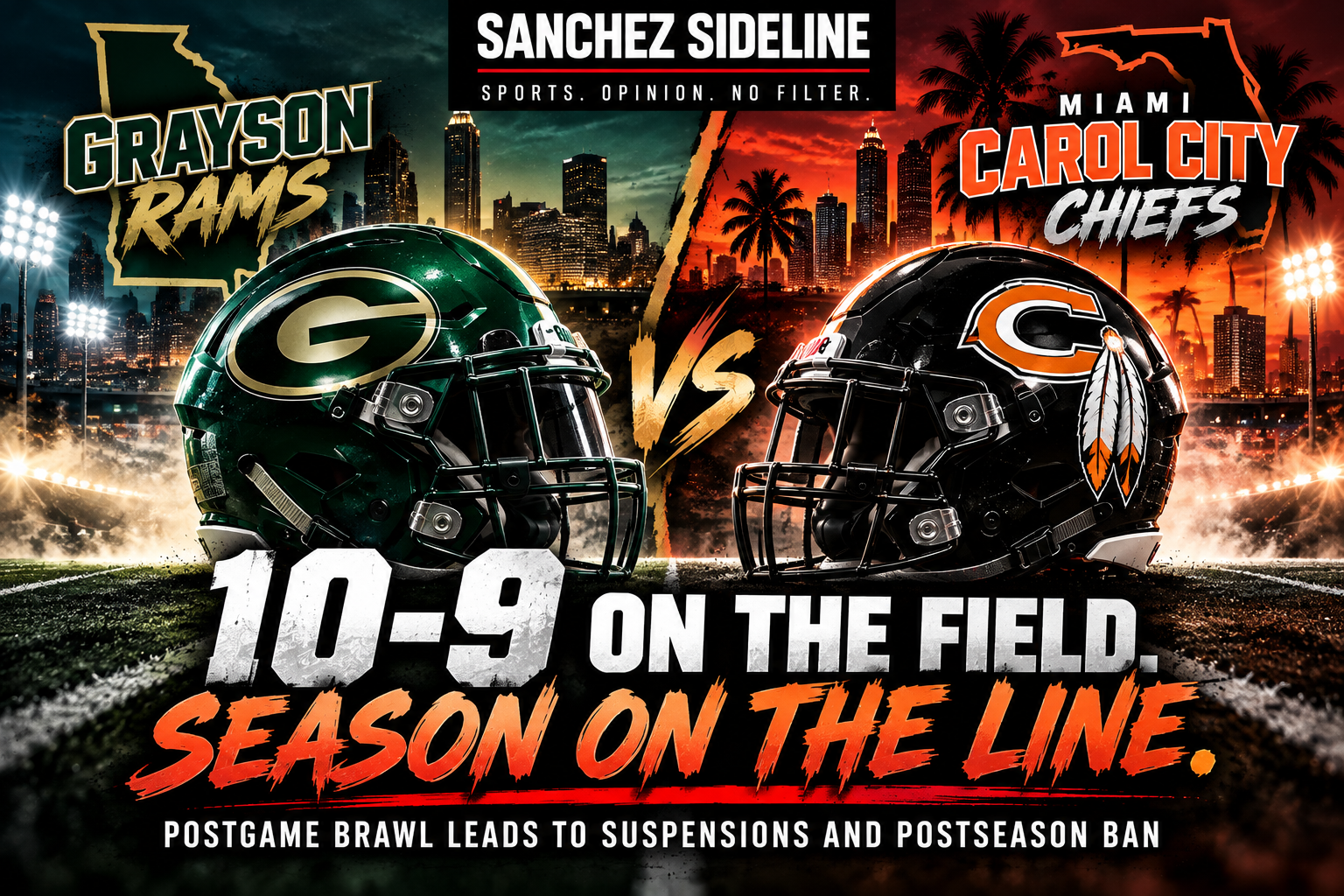
What should have been remembered as a hard-fought Georgia–Florida football showdown ended in chaos. Now Miami Carol City is banned from postseason competition, Grayson has four players suspended, and the fallout is raising serious questions about accountability, sportsmanship and punishment.
By Sanchez Sideline
Y'all, we need to talk about what happened in Loganville, Georgia.
Because somewhere between the final whistle and the postgame handshake, a football game turned into something nobody should be celebrating.
On Friday, October 2, the Grayson Rams hosted the Miami Carol City Chiefs in a matchup between two high-profile high school football programs.
The game itself?
A defensive battle.
Grayson escaped with a 10–9 victory.
One point.
Sixty minutes of football decided by the smallest possible margin.
But instead of everybody heading home talking about defensive stops, missed opportunities and a hard-earned win, we're discussing a postgame brawl that has now cost Miami Carol City its opportunity to compete for a state championship.
And that's where this story gets serious.
Because these aren't professional athletes collecting million-dollar checks.
These are high school students.
And some of them just learned how quickly one terrible decision can change an entire season.
THE GAME: GRAYSON SURVIVES, 10–9
Before everything went left, there was actually a football game worth discussing.
Grayson opened the scoring when quarterback Deuce Smith connected with Joey Hunter for a first-quarter touchdown.
Ricardo Martinez converted the extra point and later added a field goal, giving the Rams a 10–0 halftime lead.
Miami Carol City responded in the second half with a touchdown but missed the extra point.
The Chiefs later added a field goal to pull within one.
10–9.
And that's where the scoreboard stayed.
Grayson had survived a tough challenge from a Florida program that wasn't interested in making the trip north just to collect a loss.
Both teams entered the matchup with plenty to prove.
Unfortunately, what happened after the game overshadowed everything that happened during it.
THE HANDSHAKE LINE THAT TURNED INTO A BRAWL
We've all seen the postgame routine.
The clock hits zero.
Players meet at midfield.
They shake hands, exchange a few words and head toward their respective sidelines.
Sometimes there's frustration.
Sometimes there's trash talk.
But the expectation is simple.
The game is over. Leave it on the field.
That didn't happen Friday night.
Video circulating on social media shows players from Grayson and Miami Carol City gathering in the postgame handshake line before tensions escalated into pushing and physical confrontations.
Within moments, the situation spread across the field.
Players from both teams became involved.
Punches were thrown.
Coaches and other personnel "attempted" to separate the groups.
One particularly disturbing portion of the footage appears to show a Grayson player on the ground while multiple Carol City players strike toward him.
A Carol City coach intervened and helped separate the players.
And I'm going to say something right here.
There is absolutely nothing tough about multiple players attacking somebody who's already on the ground.
Nothing.
That's not football.
That's not defending your teammate.
That's not representing your school.
That's dangerous.
We can debate how the confrontation started. We can question whether words were exchanged or whether somebody took the trash talk too far.
But none of that excuses what happened afterward.
There has to be a line.
And Friday night, that line was crossed.
THE PUNISHMENT: CAROL CITY LOSES ITS POSTSEASON
Now here's where the consequences get real.
Following its investigation, the Florida High School Athletic Association handed down significant sanctions against Miami Carol City.
Fifteen players were suspended.
The breakdown:
- Four players: Suspended for the remainder of the season.
- Nine players: Five-game suspensions.
- Two players: One-game suspensions.
But the punishment didn't stop there.
The FHSAA also placed Miami Carol City's football program on restrictive probation, imposed a $1,500 fine, and declared the Chiefs ineligible for postseason competition during the 2026–27 school year.
Let that sink in.
The entire football program is now facing the possibility of having its championship hopes eliminated.
Not because another team beat them in the playoffs.
Not because they failed to qualify.
But because of what happened after a regular-season football game.
Carol City is reportedly preparing to appeal the sanctions.
And that appeal could become just as important as anything remaining on the Chiefs' schedule.
GRAYSON WAS PUNISHED TOO — BUT NOT THE SAME WAY
Now, here's where I have questions.
Because Miami Carol City wasn't the only team involved in that fight.
Grayson players were involved too.
The Georgia High School Association suspended four Grayson players for one game each.
Those players are expected to miss the Rams' October 9 region opener against Archer.
That's the punishment announced for Grayson.
Four players.
One game each.
Meanwhile, Miami Carol City has 15 players suspended, four facing season-ending penalties, and an entire program banned from postseason competition.
That's a significant difference.
And I'm not automatically saying the punishment should have been identical.
Different players may have committed different violations.
The associations operate under different rules.
And the evidence reviewed by each organization may not have been the same.
But when the consequences are this far apart, the public deserves to understand why.
Because accountability should be based on conduct.
Not which state your school happens to be located in.
BUT DOES THE PUNISHMENT FIT THE INCIDENT?
Here's where I think we need to be careful.
It's easy to watch a video, get angry and immediately demand the harshest punishment possible.
And some of what we saw absolutely deserves serious consequences.
But we're talking about an entire football program.
That includes players who may never have thrown a punch.
Players who walked away.
Players who tried to stop the confrontation.
Seniors who may have been looking at their final opportunity to compete for a state championship.
Should those players lose their postseason because of what their teammates did?
That's a legitimate question.
The FHSAA clearly believes the incident warrants program-wide consequences.
And there's an argument for that.
A football team is supposed to function as a unit. Coaches are responsible for maintaining discipline. Schools are responsible for establishing standards.
But there's also a difference between holding a program accountable and punishing every player regardless of individual involvement.
Both sides of that conversation deserve consideration.
CAROL CITY WAS ALREADY UNDER THE MICROSCOPE
And this wasn't Miami Carol City's first encounter with the FHSAA this season.
The program had previously faced sanctions related to player eligibility, including forfeitures, financial penalties and administrative probation.
Those earlier penalties involved a separate matter, and they should not be confused with the October 2 fight.
Still, they add another layer of scrutiny to a program already dealing with significant challenges.
Now the Chiefs are preparing for a rivalry matchup with Miami Northwestern on Friday, October 9, while also fighting to preserve their postseason eligibility.
Imagine trying to prepare teenagers for one of their biggest games of the season while the future of their entire season is being debated off the field.
That's a difficult position for any coaching staff.
THE BIGGER PROBLEM: WE'RE LOSING THE LESSON
Here's what bothers me most.
High school football is supposed to teach young people something beyond how to tackle, throw a touchdown pass or win a championship.
Discipline.
Accountability.
Respect.
Handling adversity.
Learning how to lose without losing control.
Because the truth is, life isn't going to let you win every time.
Sometimes you lose by one point.
Sometimes the referee makes a call you disagree with.
Sometimes somebody talks trash.
Sometimes somebody gets in your face.
And you still have to control yourself.
That's not weakness.
That's maturity.
And it's a lesson these young men are going to need long after their final football game.
THE SANCHEZ SIDELINE TAKE
I'm not going to sit here and pretend what happened after Grayson and Miami Carol City was acceptable.
It wasn't.
Players who participated in the violence should face consequences appropriate to their actions.
And coaches, administrators and athletic associations have every right to demand better.
But I also believe punishment should be transparent, consistent and proportionate.
If one program receives a postseason ban while the other receives four one-game suspensions, explain the difference.
Show how the rules were applied.
Make it clear what conduct resulted in each penalty.
Because the goal shouldn't simply be to make an example out of somebody.
The goal should be to make sure this doesn't happen again.
Grayson won the game 10–9.
But right now, that score feels almost irrelevant.
Miami Carol City is facing a postseason ban. Nineteen players across the two programs have received suspensions. And a matchup that should have been remembered for competitive football is now a cautionary tale.
One game.
One postgame confrontation.
Consequences that could last the entire season.
And here's the part I hope every high school football player understands:
The scoreboard resets next Friday. Your decisions don't always reset with it.
That's the real story.
Local Teams. Real Stories. No PR Answers.
Sports. Opinion. No Filter.
Sanchez Sideline.