
SANCHEZ SIDELINE MEDIA • NO PR ANSWERS • TUESDAY, OCTOBER 13, 2026
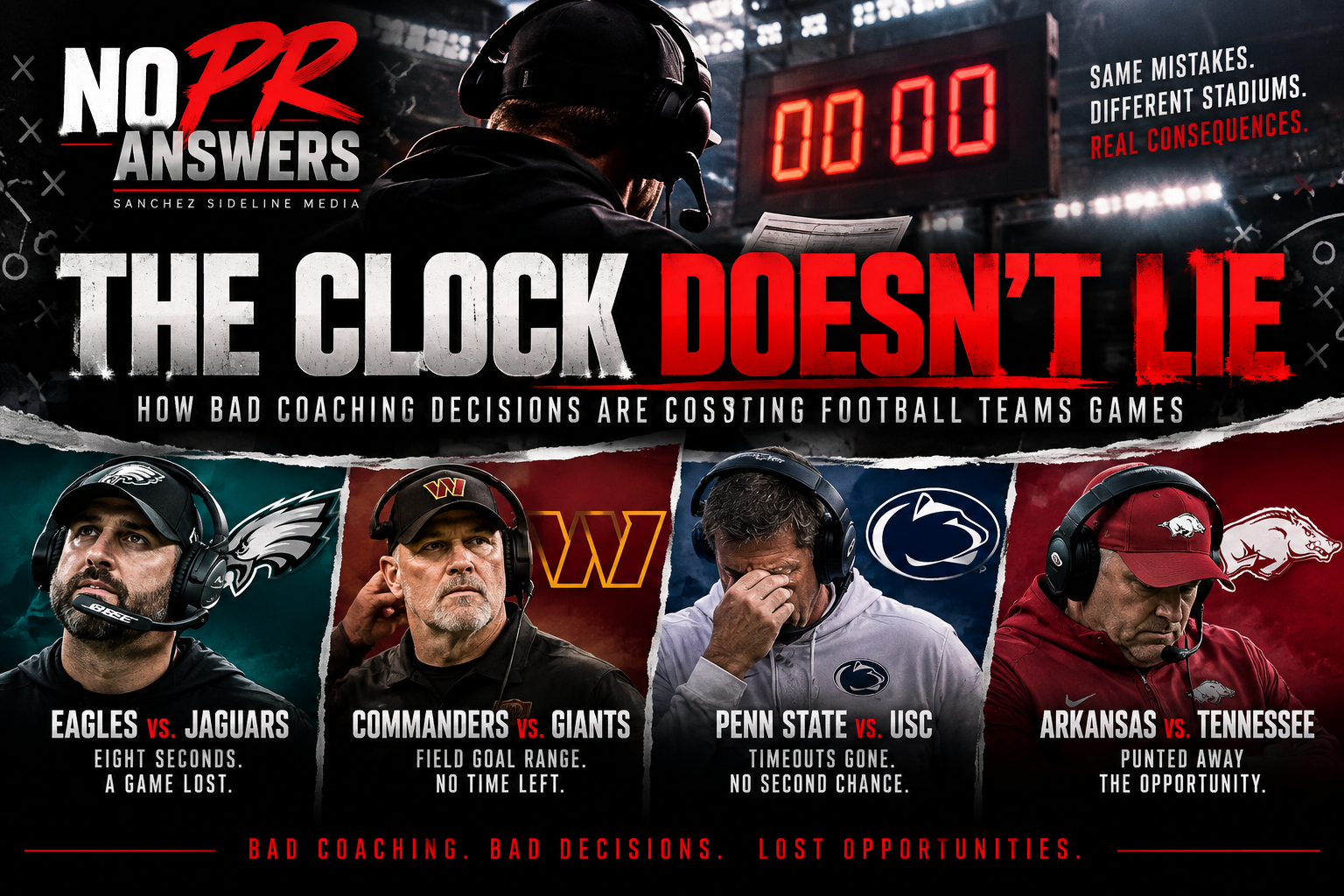
From Philadelphia and Washington to Penn State and Arkansas, this weekend exposed an uncomfortable truth: sometimes the biggest mistake on the football field isn't made by a player. It's made by the person holding the headset.
By Latifa Sanchez | Sanchez Sideline Media
There are 60 minutes in a football game.
Sixty minutes to execute a game plan, make adjustments, manage personnel, and put your team in position to win.
And somehow, after all those hours of preparation, film study, meetings, and millions of dollars invested in coaching staffs, we're still watching football games get thrown away because somebody on the sideline apparently forgot how a clock works.
I'm not talking about a quarterback throwing an interception. I'm not talking about a running back fumbling at the goal line or a kicker missing a field goal.
Those are execution mistakes. They happen.
I'm talking about decisions made by the people who are supposed to know better.
When to call a timeout. When to spike the football. When to kick it. When to stop trying to be the smartest person in the stadium and simply take the points.
This past weekend, October 10–12, gave us several examples across the NFL and college football.
And after watching some of these endings, I have one question:
What exactly are we paying these coaches to do if they can't manage the most important minutes of a game?
Philadelphia Eagles: Eight Seconds Shouldn't Cost You a Football Game

Let's start in London, because what happened to Philadelphia was almost unbelievable.
The Eagles were trailing Jacksonville 16–14 late in the fourth quarter. Jalen Hurts helped move Philadelphia into position for Jake Elliott to kick a 48-yard field goal.
Elliott made it.
Philadelphia led 17–16.
Eight seconds remained.
Eight.
And somehow, the Eagles lost 19–17.
Instead of ensuring Jacksonville started deep in its own territory, Philadelphia kicked a returnable ball. Ameer Abdullah returned it 53 yards, setting up Cam Little's 57-yard game-winning field goal as time expired.
Now, I understand the argument that a kickoff return might consume the remaining seconds. That's a legitimate strategy under certain circumstances.
But it also introduces risk.
A big return. A coverage breakdown. A penalty. One mistake that gives the opponent a chance.
And that's exactly what happened.
Philadelphia also faced criticism for decisions on its preceding offensive possession that left time on the clock.
Nick Sirianni accepted responsibility afterward.
Good.
He should have.
But here's my problem.
Taking accountability in a press conference doesn't put a victory back in the win column.
Saying you made the wrong decision doesn't change the fact that your players fought for nearly four quarters, put themselves in position to win, and then watched the game slip away because of the final sequence.
This wasn't Jacksonville marching 80 yards downfield against a tired defense.
This was an opponent needing one special-teams play and one kick.
And Philadelphia gave them the opportunity.
NO PR ANSWER: You cannot preach situational football all week and then fail the situation when it matters most.
Washington Commanders: You Were in Field Goal Range. Kick the Damn Ball.

If Philadelphia's ending was frustrating, Washington's was downright ridiculous.
The Commanders and New York Giants finished in a 27–27 tie.
But that result doesn't tell the whole story.
Washington had already blown a 14-point fourth-quarter lead. Then, in overtime, the Commanders recovered a Giants fumble and worked their way into field-goal range.
With the football at the Giants' 24-yard line and 12 seconds remaining, Washington had a chance to attempt the winning kick.
There was one problem.
No timeouts.
Instead of stopping the clock and setting up the field goal, Jayden Daniels took another snap, looked for an opportunity, and ended up down inbounds.
The seconds disappeared.
The kicking unit never got onto the field for an attempt.
Game over.
Tie.
A tie that absolutely felt like a loss.
Dan Quinn accepted responsibility, explaining that he should not have put Daniels in that situation.
And I agree.
Because this wasn't solely about what the quarterback did.
This was about the entire decision-making process.
You have a young quarterback. You have no timeouts. You're already in reasonable field-goal range. The game is sitting right there waiting to be won.
Why are we still gambling with the clock?
Yes, a shorter field goal is preferable.
But you know what's even more preferable?
Actually attempting one.
And that's what makes this so frustrating.
Washington wasn't beaten on a last-second touchdown.
The Commanders weren't denied by some miraculous defensive stand.
They ran out of time while trying to improve a situation that was already good enough to give them a chance.
Commanders minority owner Magic Johnson publicly criticized the clock management afterward. And when even someone in the ownership group is expressing disbelief, that tells you how glaring the mistake was.
NO PR ANSWER: Field-goal range means nothing if you never give your kicker a chance to kick.
Penn State: You Can't Save the Game When You've Already Spent Your Timeouts

Let's move to college football, because apparently the clock-management problem doesn't end when coaches leave the NFL.
Penn State lost to USC 31–23 on Saturday.
And while there were multiple reasons for that result, Matt Campbell's timeout management deserves serious examination.
With 4:15 remaining, USC lined up as though it might attempt a fourth-and-four from deep in its own territory.
Penn State had its punt-return personnel on the field.
Campbell called his final timeout to make sure the team was properly aligned for the situation.
USC eventually punted.
Penn State got the ball back with 3:59 remaining.
But the Nittany Lions had no timeouts left.
After Penn State's ensuing possession ended in a turnover, USC was able to finish the game without giving the ball back.
Here's where I have a problem.
I understand wanting the correct personnel on the field. I understand avoiding a special-teams disaster.
But how does a major college football program find itself burning its final timeout because its personnel aren't ready?
That's not just a clock-management issue.
That's preparation.
That's communication.
That's situational awareness.
And when you're trailing late in the fourth quarter, every timeout is valuable.
You can't spend them carelessly and then wonder why you don't have enough opportunities left.
To be fair, the timeout itself didn't directly cause Penn State's turnover. The players still had an opportunity to execute.
But coaching decisions determine the margin for error.
And Penn State's margin was practically nonexistent.
NO PR ANSWER: A timeout should be a strategic weapon, not an emergency repair kit for sideline confusion.
Arkansas: Playing Not to Lose Is Sometimes the Fastest Way to Lose

Arkansas gave us a different kind of late-game decision.
Trailing Tennessee 24–17, the Razorbacks got the ball back with 1:57 remaining.
They needed a touchdown.
After three consecutive incompletions, Arkansas faced fourth-and-10 from its own 25-yard line.
And the Razorbacks punted.
Tennessee took possession with 1:36 remaining. Arkansas used its three timeouts, but Tennessee gained a first down and eventually ran out the clock.
Now, I understand the thinking.
Fourth-and-10 from your own 25 is not an easy conversion.
Fail, and you're giving Tennessee the football deep in your territory.
But let's talk about the alternative.
You're down seven.
There's less than two minutes remaining.
You're giving the football back to an opponent that only needs to move the chains to put the game away.
What exactly are you protecting?
Field position?
The final score?
The appearance of making the conservative decision?
Sometimes the risk of going for it is less damaging than the risk of never seeing the football again.
And in this case, Arkansas never got another meaningful opportunity.
This wasn't purely a clock-management mistake. It was a fourth-down decision that became a clock-management gamble.
That's an important distinction.
But the result was the same: the coaching staff placed its remaining chances in the hands of the opponent.
NO PR ANSWER: When you're running out of time, playing it safe isn't always smart football. Sometimes it's surrender dressed up as strategy.
When Did Coaching Become More Complicated Than Common Sense?
Here's what bothers me most about all four situations.
These aren't inexperienced staffs coaching their first games.
These are professional and major-college programs with analysts, coordinators, assistants, technology, film departments, and countless resources dedicated to preparation.
Some staffs have specialists whose entire responsibility is helping coaches understand game situations.
Yet we're still watching teams waste timeouts because the wrong personnel are on the field.
We're watching offenses run unnecessary plays when a field goal could win the game.
We're watching teams give opponents one final chance because they misjudge the risk of a kickoff.
And we're watching coaches make conservative decisions that leave their own offenses standing on the sideline as the clock expires.
At some point, the explanation can't always be that football is complicated.
Of course football is complicated.
That's why these coaches are paid what they're paid.
That's why they have entire staffs.
That's why they spend the week preparing for situations that may arise on Sunday or Saturday.
And here's another thing.
We are quick to criticize players for mental mistakes.
A receiver runs the wrong route? He gets called out.
A defensive back blows coverage? Everybody wants to know why he was on the field.
A quarterback makes the wrong read? His ability to lead the franchise gets questioned.
But a head coach makes a questionable decision with the entire game hanging in the balance, and suddenly we're talking about how difficult the job is.
No.
The standard has to apply to everybody.
Including the people wearing headsets instead of helmets.
The Accountability Check
Three questions every NFL and college football coaching staff should be able to answer.
1. Who is actually responsible for clock management?
If the head coach is handling play calls, personnel, officials, challenges, and game strategy, who is independently monitoring the clock and communicating the options?
2. Are teams practicing late-game situations enough?
Not just two-minute drills for quarterbacks. I'm talking about the entire staff rehearsing timeouts, fourth-down decisions, clock-stopping situations, kickoff strategy, and field-goal preparation.
3. Why aren't coaching mistakes treated with the same scrutiny as player mistakes?
Players lose starting jobs over poor execution. Coordinators get replaced over bad schemes. But when repeated clock-management failures occur, what meaningful changes are being made?
Those aren't unfair questions.
They're the questions that should be asked every time a team loses an opportunity because of something that could have been prepared for.
Final Whistle: The Clock Doesn't Care About Your Salary, Reputation, or Excuses
Here's where I stand.
I'm not expecting coaches to be perfect.
Football is unpredictable. Players make mistakes. Officials make mistakes. Sometimes the other team simply makes a better play.
That's sports.
But there is a difference between losing because the opponent beat you and losing because your own decision-making put your team in an unnecessarily difficult position.
Philadelphia had eight seconds to protect a lead.
Washington had a chance to attempt a game-winning field goal.
Penn State needed every possible opportunity to get the football back.
Arkansas needed one more possession to have a realistic shot at tying the game.
Four different programs.
Four different circumstances.
One uncomfortable theme.
The people responsible for managing the game didn't always manage the situation.
And here's the part I really want coaches to understand.
Your players don't get those opportunities back.
They don't get another fourth quarter because you misused a timeout.
They don't get another overtime because you waited too long to send out the kicking unit.
They don't get to replay the final eight seconds because you made the wrong strategic call.
They live with the consequences.
So should the people making the decisions.
Because at the end of the day, the clock doesn't care how many championships you've won, how much money you make, or how impressive your résumé looks.
When it hits zero, it's over.
And sometimes, the opponent didn't beat you.
Your own sideline did.
That's NO PR Answers.
© 2026 Sanchez Sideline Media. All rights reserved.