
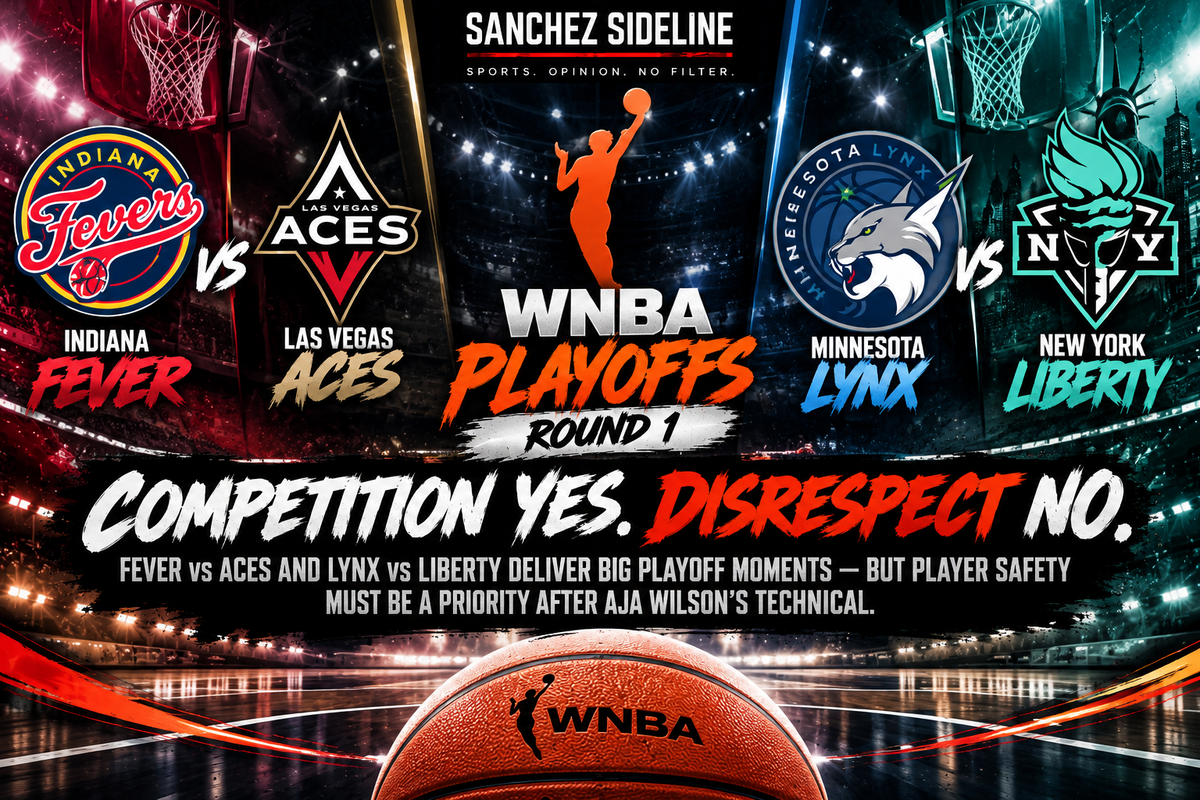
The Fever refused to go home, the Liberty sent the No. 1 seed packing, and an ugly courtside exchange involving A’ja Wilson raised a bigger question the WNBA cannot ignore: where does being a fan end and disrespect begin?
Tuesday night gave us everything playoff basketball promises.
Pressure. Stars showing up. An elimination game forced. History made.
And unfortunately, another reminder that buying a ticket does not mean buying unlimited access to the athletes on the court.
Indiana responded to its Game 1 beating by defeating Las Vegas 99–89, evening that series at 1–1 and forcing a winner-take-all Game 3. A few hours later, New York completed the night's biggest statement, beating Minnesota 87–71 to sweep the league's No. 1 seed right out of the playoffs.
That's enough basketball drama for one night.
But then there was the A'ja Wilson situation.
And we're not skipping over it.
Fever 99, Aces 89: Indiana Said Not Today
Remember Sunday?
Las Vegas beat Indiana 102–85, A'ja Wilson dropped 38 points and 16 rebounds, and the Fever looked like a team that might be headed home quickly.
Apparently Indiana remembered too.
Because Tuesday looked completely different.
Caitlin Clark finished with 27 points, 15 assists and six rebounds, while Kelsey Mitchell poured in another 26 points. Clark had already collected 14 points and 11 assists by halftime, becoming the first player in WNBA history to record a points-assists double-double in the first half of a playoff game.
That's one way to respond after calling your team's Game 1 performance an “F.”
Indiana trailed by 11 early before flipping the game with a 20–6 second-quarter run. The Fever carried a 48–43 lead into halftime and eventually stretched their advantage to 15 in the third quarter.
Las Vegas wasn't finished.
Of course they weren't.
The Aces opened the fourth quarter with an 11–4 run and got the deficit down to five.
Then Indiana steadied itself.
Even after Clark fouled out late, the Fever finished the job.
99–89.
Series tied.
Game 3 in Las Vegas.
Winner moves on.
Loser starts planning vacation.
Now that's playoff basketball.
And Then the Basketball Became Secondary
With 4:10 remaining and Indiana leading 90–79, Sophie Cunningham was called for a blocking foul during a play involving Wilson.
Then Wilson's attention shifted toward a fan sitting near the baseline.
Wilson removed her mouthguard, approached the area and exchanged words with the spectator while pointing toward him. Teammates, staff and security became involved.
The officials assessed Wilson a technical foul.
Wilson later apologized to her teammates for costing them the technical.
But she did not apologize for believing a line had been crossed.
According to Wilson, she saw the man stepping toward her and pointing at her. She described the interaction as unacceptable and said she would not tolerate that type of behavior.
The Fever later said arena security interviewed the fan and witnesses and determined that the situation did not violate the team's Fan Code of Conduct. The spectator therefore was allowed to return to his seat.
So there are two things we need to separate here.
Security's determination about whether a written policy was violated is one thing.
The larger issue of player protection and boundaries is another.
Sanchez Sideline: Arenas Have to Do Better
We're going to say this plainly.
Disrespect is not okay.
Not toward A'ja Wilson.
Not toward Caitlin Clark.
Not toward Angel Reese.
Not toward some rookie sitting at the end of the bench whose name isn't trending on social media.
No player. No day.
Fans pay for a seat.
They pay to cheer.
They pay to boo.
They can complain about officiating, scream when their team misses a free throw and spend the ride home explaining exactly how they would've coached the fourth quarter better.
That's sports.
What they don't purchase is ownership over the athletes.
And courtside seating especially creates a responsibility for arenas because the physical separation between spectator and athlete is almost nonexistent.
When an athlete believes a spectator is moving toward them aggressively, arena personnel shouldn't be figuring out the seriousness of the situation after the player has already felt compelled to confront it.
Security needs to be close enough, attentive enough and empowered enough to intervene before it reaches that point.
That protects the player.
It protects the fan.
And frankly, it protects the league from something far worse happening someday.
A'ja Got the Technical — Fine. But Don't Stop There.
Officials had a basketball decision to make.
Wilson engaged with someone in the stands, and she received a technical foul.
She acknowledged afterward that the technical hurt her team and apologized to her teammates.
Fine.
But handing out the technical cannot become the end of the conversation.
Because Becky Hammon said afterward that she had essentially never seen Wilson react that way and believed her player's reaction showed how disrespected she felt.
That matters.
It doesn't independently establish exactly what the spectator said or prove a violation of the arena's conduct policy. Security said its review didn't find one.
But when a player who normally doesn't react that way suddenly does, you investigate seriously.
And you make sure your procedures are strong enough that athletes never have to wonder whether they're protected simply because the person confronting them bought an expensive seat.
Cheering is part of the ticket. Harassment isn't.
There's a line.
Keep it.
Now back to basketball.
Liberty 87, Lynx 71: The No. 8 Seed Just Sent No. 1 Home
Well...
Didn't see this coming.
New York entered the playoffs as the eighth seed.
Minnesota entered at 33–11, owner of the best regular-season record in the WNBA.
Two games later?
Minnesota is done.
The Liberty defeated the Lynx 87–71 Tuesday at Barclays Center, completing a 2–0 sweep and becoming the first No. 8 seed in WNBA history to eliminate a No. 1 seed.
Read that again.
The team with the best regular-season record didn't win a playoff game.
New York didn't even make Minnesota feel particularly comfortable Tuesday.
The Liberty never trailed.
That's not sneaking out with an upset.
That's walking into the postseason bracket, grabbing a marker and rewriting it yourself.
New York's Big Three Said Enough Playing Around
After Breanna Stewart torched Minnesota for 34 points and 12 rebounds in Game 1, the Lynx knew where the problem was.
Game 2's solution?
Apparently there wasn't one.
This time the damage was spread around.
Jonquel Jones: 21 points, 13 rebounds.
Breanna Stewart: 21 points, five rebounds, four assists — while playing all 40 minutes.
Sabrina Ionescu: 18 points, seven assists and four rebounds.
Pick your poison.
New York spent much of the regular season looking inconsistent and dealing with injuries.
Then the playoffs arrived and somebody apparently flipped the switch labeled:
Oh yeah, we're the Liberty.
Minnesota spent the entire regular season earning the No. 1 seed.
New York needed approximately 80 postseason minutes to make it irrelevant.
Brutal.
That's Why You Play the Games
Seeds matter.
Regular-season records matter.
Home-court advantage matters.
Until somebody throws the ball in the air.
Then none of it can save you.
Minnesota had the league's best regular-season record.
New York had the eighth seed.
New York won Game 1 by 16.
Then won Game 2 by 16.
That's not luck.
That's a sweep.
And now the Liberty are heading to the semifinals while Minnesota gets the cruelest postseason reminder imaginable:
33 regular-season wins don't come with playoff insurance.
Sanchez Sideline Final Take
Tuesday gave the WNBA two very different stories.
Indiana showed us what desperation basketball is supposed to look like.
New York showed us why postseason seeding guarantees absolutely nothing.
And the situation involving Wilson showed us something more important than either final score.
These women are competitors.
They'll hear boos.
They'll get heckled.
They'll play in hostile arenas.
That's professional sports.
But they're also human beings.
There is no championship, rivalry, jersey, ticket price or courtside seat that changes that.
The WNBA wants packed buildings.
It wants passionate crowds.
It wants rivalries people care enough about to scream over.
Good.
That's growth.
But as the crowds get bigger and the emotions get hotter, player protection has to grow with them.
Because players shouldn't have to protect themselves from spectators.
That's what arena security is there to do.
Be loud. Be passionate. Root for your team.
Just don't forget how to respect the people playing the game.
Sports. Opinion. No Filter.